The Sketchbook Before the Finished Work
Learn how to use a sketchbook before a piece is finished: choose a format, organise experiments and make pages easy to work on without polishing them.
When a sketchbook page feels too messy to use, the problem is often not the mess but the lack of a clear working purpose. A sketchbook for creative practice can hold tests, notes and materials in progress without asking each page to look finished.
Think of the book as a place to make and compare things, rather than a record that must explain itself to an audience. A few choices about format, tools and page layout can make it easier to begin without turning the book into a filing system.
What should a sketchbook page include?
A useful page needs room for the work itself and enough context to make the task clear. Include a drawing, written fragment, material test or other attempt, then add a short prompt or label if it helps you understand what you are doing.
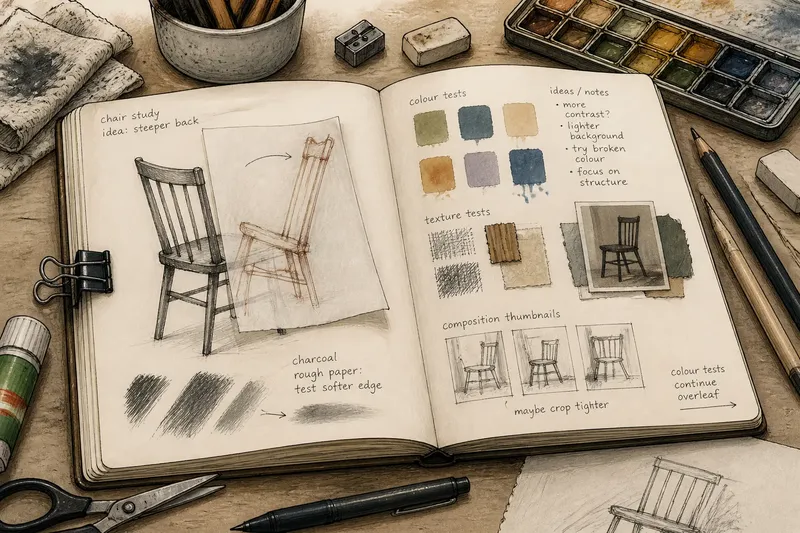
For example, “charcoal, rough paper; test a softer edge” tells you more than “bad drawing”. Leave open space where it helps you compare marks or add another attempt, but do not feel obliged to fill it.
How do you choose a sketchbook and tools?
Match the paper to the materials you expect to use. A pencil or biro can work on many ordinary pages; wet media may need paper intended for watercolour or mixed media. If you are unsure, try a small mark near the back of the book before committing a full page.
Also consider whether the book opens comfortably and is easy to carry to the places where you work. A hardback book can give you a firm surface away from a desk, while a loose pad may suit larger experiments that need to be rearranged.
- If pencil lines smudge on the paper, use a less soft pencil or choose a surface that holds the mark more clearly.
- If a wet brush leaves the page buckled or torn, stop using that medium in the book and switch to suitable watercolour paper.
- If the book will not stay open, hold it with a clip or choose a binding that lies flatter.
- If small pages constrain a broad composition, test it on a larger loose sheet and attach or store the result separately.
- If carrying the book makes you leave it at home, choose a smaller or lighter format for work away from your usual space.
- If several materials need different surfaces, keep a mixed-media book for compatible tests and use separate paper for the rest.
How can you use a page without making it a portfolio piece?
A portfolio is arranged to present work to someone else; a working sketchbook can be arranged for the task in front of you. It may contain crossed-out marks, scraps, blunt notes or an awkward first attempt, provided those things help you make the next move.
Say you have a blank page, a graphite pencil and a small piece of tracing paper, and you want to alter the angle of a chair’s back. Draw the chair on the page, place the tracing paper over it, then sketch a steeper angle on the overlay. The original drawing remains visible beneath the change, so you can decide whether the new angle clarifies the shape before redrawing the whole chair.
How can different page arrangements support different work?
A single large drawing benefits from a clear field, while a comparison may need several small attempts placed side by side. For writing, leave a margin for alternate phrases; for collage, reserve space for pasted pieces and their edges.
When a page is crowded, continue on the next one and write a simple pointer such as “colour tests continue overleaf”. If an idea needs a different scale or surface, use loose paper rather than forcing it into the book.
Which sketchbook questions should you settle first?
Does a sketchbook need to be neat?
No. It needs to be usable for the work you are doing, not tidy for an imaginary viewer. If a mark or material is hard to identify, add a brief label; otherwise, leave the page as it is.
Should I use one sketchbook for every kind of work?
One book can suit work that shares tools and paper, while separate books can make sense when the materials need different surfaces. Choose the arrangement that lets you start without searching for the right place or avoiding a medium.
What should I do with pages I dislike?
Decide whether the page is still useful for the current task. If it is, add a note or continue nearby; if it is not, turn the page, cover it or remove it if the binding allows.
When should I move an idea into a finished piece?
Move it when you know what form the next piece needs and the sketchbook no longer offers suitable space or materials. You can then work on the separate piece without requiring the sketchbook page to become presentable.
How do you keep the sketchbook easy to use?
Keep the tools you use most often within reach, such as a pencil, eraser, glue stick or small scissors. Put materials away when they make the book awkward to handle, and use a loose sheet when a test risks damaging the page.
For a sketchbook for creative practice, usefulness comes from matching the page to the task: enough room to work, a surface that suits the material and a layout you can read at a glance. Before closing the book, check that the next blank page is ready for the tools you plan to use; if it is not, choose a suitable sheet or material first.