A Constraint Gives an Idea a Working Edge
A creative constraint can turn a vague idea into a workable next move. Learn how to choose a limit, test its fit and adjust it without losing options.
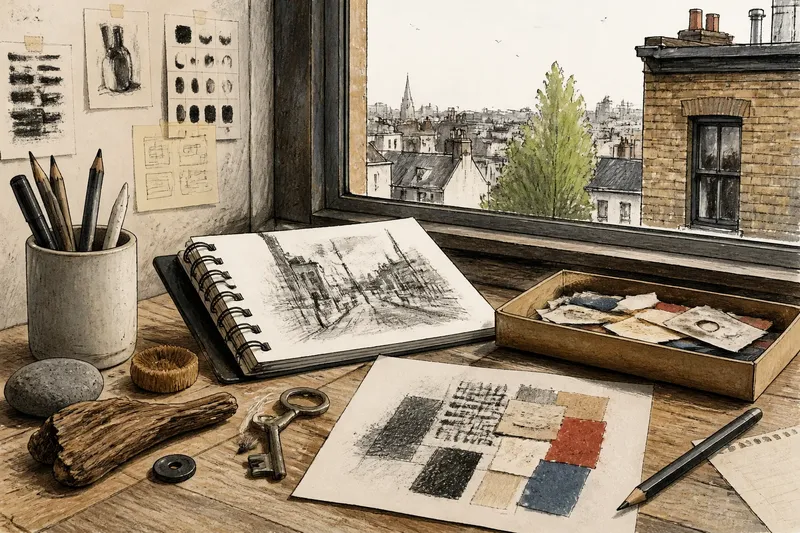
You have a blank page, a handful of found objects or an instrument within reach, but no clear first move. A creative constraint can turn that open field into a choice you can act on: write a scene using overheard phrases, arrange objects by texture, or compose with a repeated rhythm.
The point is not to make the work difficult. Choose a limit that directs your attention towards something specific while leaving decisions for you to make. A useful constraint shapes the process without dictating the finished work.
What makes a creative constraint useful?
A constraint is a deliberate boundary on one part of the work. It might limit materials, subject, form or a particular technique. Its value lies in how it changes your next decision, not in how unusual or severe the rule sounds.
Connect the boundary to the problem in front of you. If a sketch is buried in detail, drawing with a broad marker can make you consider larger shapes first. If a melody keeps losing its direction, repeating a short rhythmic pattern may give you something stable to vary.
Keep the first rule narrow enough to understand at a glance. Combining a restricted palette, a fixed subject and a prescribed composition can make it hard to tell which boundary is shaping the result. Begin with the one that addresses your current sticking point.
How can you choose a constraint that has a clear purpose?
State what the limit should help you notice or decide. “Use fewer tools” is vague; “draw the market stall with charcoal only, so I must separate forms through light and dark” names both the action and its purpose. You can then judge the rule by what it brings into view.
Match the constraint to the kind of uncertainty you face. A subject limit helps when the idea is too broad; a material limit can focus attention on handling and texture; a formal limit, such as writing in dialogue, can change how information reaches the reader.
Say you have a box of ticket stubs, a pencil and a sheet of scrap paper, and want to make a small collage but cannot choose an arrangement. You decide to place the stubs by colour and use pencil only for connecting marks; after arranging them, you can see which colours cluster and whether a line can create a route through them. If the paper still feels crowded, you can remove one stub rather than adding another rule.
How much freedom should the rule leave?
A constraint can become a complete plan if it decides the subject, materials, composition, mood and ending all at once. That may suit a technical exercise, but it leaves little space for discovery. Before starting, name several choices the rule still leaves open, such as viewpoint, sequence, texture or tone.
If every available choice seems to produce the same result, loosen one part of the boundary. A fixed colour palette could still allow changes in shape and scale; a poem limited to a single room could still shift between speakers or move through time. Keep the part that is doing useful work and reopen the part that is closing off every route.
What should you do when a constraint stops helping?
First identify where the work is getting stuck. If the rule prevents the next action, widen it slightly; if you are repeating the same action despite having room to vary it, keep the rule and change your prompt. A painter might alternate between curved and straight marks, while a writer might switch the point of view between two characters.
Some awkwardness can lead you towards unfamiliar material, but it does not need to be endured indefinitely. Notice whether the limit is making you see a new possibility or merely sending you back to the same dead end. You can carry forward a phrase, shape or sound that emerged during the attempt and leave the original rule behind.
Imagine you are making a short audio piece with a phone recorder and have chosen to use only sounds from a kitchen. You record a kettle, a cupboard door and a spoon against a mug, then find that the clips all have the same rhythm. You decide to keep the sound limit but arrange the clips from quiet to abrupt; the piece now has a changing shape, and the constraint has not forced you to add unrelated material.
Which creative constraint should you try first?
Would a time limit help me begin?
A bounded session can help when you keep waiting for a perfect starting point. Choose an end point you can honour, then use the session to make one small piece of material rather than to judge its quality; when time is up, note the next action you would take.
Should I limit the materials?
A material limit can focus your attention on what a tool can do. Choose what is already available, such as a soft pencil and scrap paper or two scraps of fabric and a needle, and observe which marks or joins become possible.
Can I constrain the subject instead?
Yes. A narrow subject, such as the view through a particular window or the sound of a door closing, gives you something concrete to examine. Leave the treatment open so the subject does not decide the form or mood for you.
When is it time to change the rule?
Change it when it repeatedly blocks a next action or leaves you with no meaningful choice. Alter one part at a time, then see whether the new boundary opens a usable route without making the original problem return.
How can you keep a creative constraint focused?
Write the rule as one plain sentence before you begin: “Arrange the objects by texture and draw only the shadows,” or “Write the exchange using only what the speaker can hear.” A short instruction is easier to hold in mind than a bundle of conditions.
- If the next action is unclear, check whether the rule names a material, subject or action; if it does not, make one of those explicit, or replace the rule with a more concrete instruction.
- If the rule decides nearly every feature, check how many choices remain about form, sequence or tone; if none remain, loosen one feature, or keep the rule only for a narrowly technical exercise.
- If you repeat the same mark, phrase or sound, check whether the boundary allows variation; if it does, add one prompt such as changing viewpoint, or widen the boundary if it does not.
- If the work stalls at a specific point, check whether the rule blocks that action; if it does, permit one exception at the blockage, or set aside the rule if the exception would swallow it.
- If the result draws your attention to useful material, check whether you can develop it without the original rule; if you can, carry it forward, or repeat the constraint once if the material still depends on it.
- If the rule feels arbitrary, check whether it addresses a real decision in the work; if it does not, connect it to a named problem, or choose a different constraint if no clear connection appears.
After the attempt, note what the limit helped you notice and where it became obstructive. For a creative constraint, the next decision might be to keep the boundary, alter one part or set it aside; that choice matters more than defending a rule simply because you chose it.
For your next session, name the problem before you choose the limit. If you cannot begin, specify a first action; if the work feels crowded, narrow one source of choice. That small distinction helps you select a constraint that guides the work while leaving its discoveries open.