Paper, Screen or Index Cards for Sorting Fragments?
Paper, screen or index cards for sorting fragments: see which format suits your material and make a clear choice about moving, grouping and revisiting ideas.
You have a handful of lines, images and questions, but no clear order yet. For sorting fragments, paper, a screen or index cards each make different relationships easier to see and work with.
A fragment is a small piece of unfinished material: a phrase, observation, question, image or character detail. The right surface depends less on a general preference than on the work in front of you: its shape, its connections and the decision you need to make next.
What should a sorting surface help you notice?
Sorting does not mean forcing fragments into a finished sequence. It means placing them in relation to one another so you can compare, group, separate or return to them.
Consider the question you are trying to answer. “Which ideas belong together?” calls for a view of several pieces at once; “Does this sentence sound right in context?” calls for continuous reading. The format should make that particular comparison easier to carry out.
Three actions are useful to distinguish. Move means changing a fragment’s position without rewriting it. Group means bringing related pieces together or setting them apart. Revisit means finding a previous idea or arrangement after your attention has shifted.
When does paper help you see relationships?
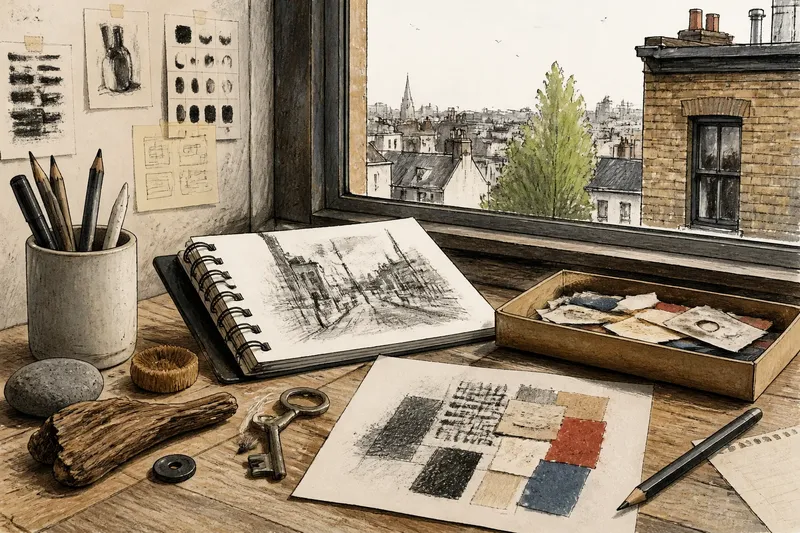
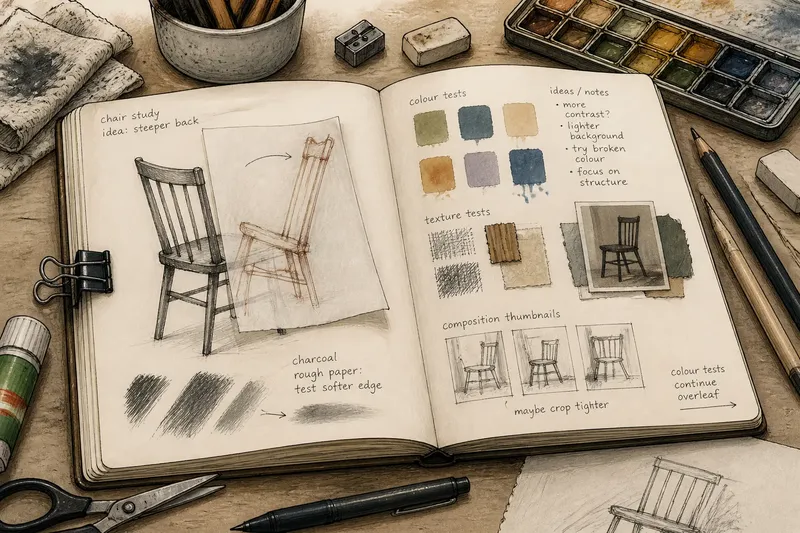
A notebook spread, loose sheets or a sheet of drawing paper gives fragments a visible place. You can put a phrase beside a sketch, draw a line between observations or leave a blank space where a connection is uncertain.
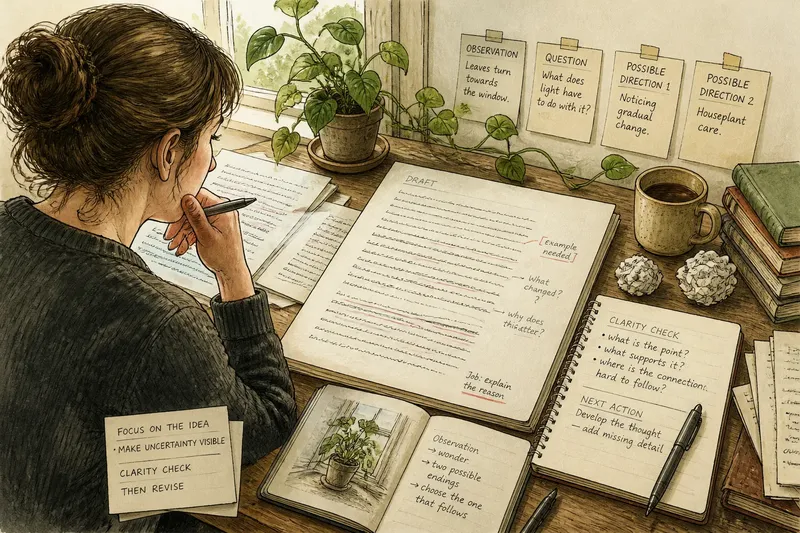
Paper works especially well when the material includes handwriting, diagrams or marks whose shape matters. A notebook keeps a dated trail, while loose sheets let you place pieces side by side; a bound page, however, is harder to rearrange than separate pages.
Handwritten notes can also record how your thinking changed: an arrow, crossed-out phrase or margin question remains beside the original idea. If the marks begin to obscure the material, make a clean copy of the arrangement you still want to consider and set the crowded page aside.
When is a screen useful for sorting fragments?
A text file or notes app is suited to lines and questions you may need to search later. A digital whiteboard, such as Miro, can give each fragment its own movable tile; a slide deck can serve a similar purpose when you want separate pieces on a sequence of pages.
Digital tools make it straightforward to duplicate a fragment, preserve an earlier version or gather notes from different files. Search and tags help when you remember a word or topic but not where you recorded it.
A screen can also hide part of the arrangement. A board may extend beyond the visible window, while a document turns a spatial comparison into a scroll. Keep the structure plain until a real retrieval problem calls for a label, tag or separate section.
Why might index cards suit independent pieces?
Index cards give each fragment its own physical space. You can spread them on a desk, move one without disturbing the others, or form temporary piles to compare possible groupings.
They are particularly useful when you expect to reconsider the same pieces in different combinations. A card can sit between two groups while you decide where it belongs, or be turned over to set the idea aside without discarding it.
Cards need room and a dependable place to stay together when they are not in use. If a fragment depends on a photograph or a longer passage, write a brief identifying note on the card and keep the full source nearby; otherwise, the card may become hard to interpret on its own.
Which format suits the action you need to take?
Compare formats by the decision you want to make, rather than treating one as a universal workspace.
- Move: If you need to shift one short fragment repeatedly, use a card or digital tile; if you need to move whole groups together, use loose sheets or select and drag a group on a digital board.
- Group: If a hand-drawn map or connecting lines matter, use a broad paper sheet; if you want to form and reform piles, use cards; if you need named groups you can reopen later, use a digital board.
- Revisit: If the date and order of your notes matter, keep them in a notebook; if you need to retrieve phrases by keyword, use searchable digital notes; if you want to return to a chosen physical set, keep the cards together in an envelope or box.
- Include images: If you want to sketch beside a phrase, use paper; if you need to compare separate image-linked notes, use cards; if you need to keep image files with links or captions, use a digital board.
- Work with other people: If everyone needs to see and handle the arrangement in the same room, use paper or cards; if collaborators are working remotely, use a shared digital board they can access.
- Keep the source visible: If a fragment relies on surrounding prose, use a document; if it stands alone, a card or tile can work; if context is easy to lose, add a source note before separating it.
Each choice has a cost as well as a convenience: paper can preserve visible marks but is difficult to search, cards make pieces easy to separate but need storage, and screens support retrieval but can conceal parts of a large arrangement. Let the cost that matters most guide the decision.
How can you choose a format for the material you have?
Start with the form of the fragments. Short, independent notes can sit on cards or digital tiles. Connected prose belongs more naturally in a document, while sketches and spatial relationships often benefit from a broad sheet or visual board.
Next, ask what you need to compare. If your question depends on seeing all the pieces at once, choose a surface that keeps them in view. If your question is about finding a line again, favour a notebook with clear page references or searchable digital notes.
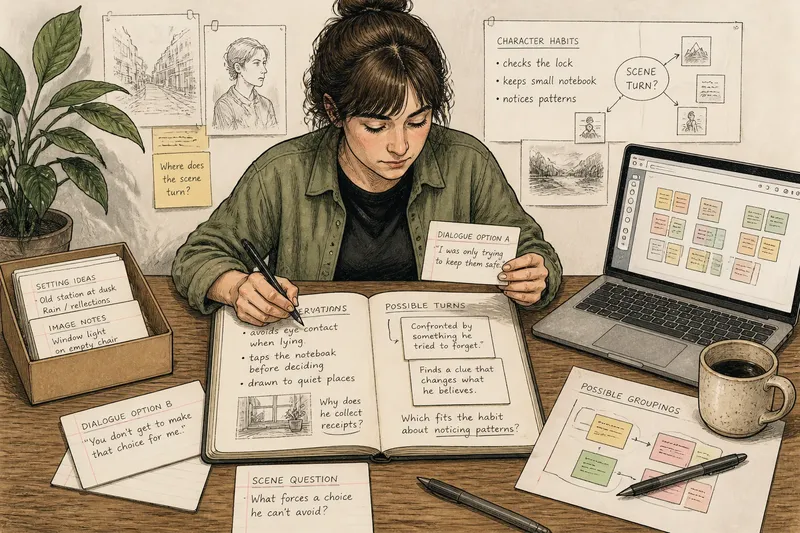
Say you have handwritten observations about a character’s habits, two possible lines of dialogue and a question about where a scene should turn. You write each dialogue line and the scene question on separate index cards, then place them beside the observations on a notebook page. One line seems to connect more clearly to a habit, so you mark that relationship in the notebook and keep both dialogue options; the result is a visible lead to investigate, not a decision to discard the other line.
Which questions help you choose a format?
Are index cards better than paper for sorting ideas?
Cards make individual fragments easy to separate and regroup, while a paper sheet is better for showing links across a continuous surface. Choose based on whether your next task is rearranging pieces or drawing relationships between them.
Is a digital board useful for writing fragments?
It suits short notes that you may need to search, duplicate or access on different devices. If you mainly want to read connected prose, use a document instead of dividing it into tiles.
Can I sort fragments in a notebook?
Yes: use a spread for a small map, and add page references when related notes sit elsewhere. If you need to move individual fragments often, use loose inserts or cards alongside the notebook.
Should I keep every fragment in one place?
Not necessarily, but each separated piece needs enough context to make sense later. Add a short source note or page reference before moving it to another surface.
For sorting fragments, choose the format that makes the next decision legible: what to connect, separate or look up again. When you return to the material, that visible decision—alongside any source note needed to recover context—will help you continue without treating a provisional arrangement as final.