The First-Draft Trap: Editing Before There Is Enough to Edit
The first-draft trap is polishing sentences before an idea has taken shape. Separate drafting from revision to make the piece’s direction easier to see.
The first-draft trap is familiar: you alter a sentence, read it again, change it back, and still cannot say what the piece is about. Often, the sentence is not the problem. The idea has not yet given it a settled job.
During drafting, sentences are provisional supports. They help you discover what you mean, even when they are awkward or out of order. Polish them too early and a half-formed thought can look finished, making it harder to see what the piece still needs.
Why does sentence editing stall a first draft?
Polishing rewards local neatness: a cleaner verb, a smoother transition, a more precise phrase. Developing an idea asks what the work is trying to say, show or make. If that larger question is unsettled, local improvements can use up attention without moving the piece towards a shape.
This often becomes clear when you keep rereading the opening. A stronger first paragraph may feel like progress, but it cannot determine what the middle needs to do. The opening may change once you discover the real emphasis, so treating it as final too soon can create rework.
A drafting snag points to something you do not yet know, such as the next event, the reason for a claim or the detail that makes an image matter. An editing task concerns wording whose purpose is already clear. Asking which kind of problem you have helps you choose where to put your attention.
What belongs in a rough first pass?
A rough pass should keep the thought moving while making uncertainty visible. It does not need to be elegant or complete; it needs enough material on the page for you to see what the idea might become.
- Write a plain-language note about the point you are trying to reach. If you can state it, continue; if you cannot, write down the question the piece is circling instead.
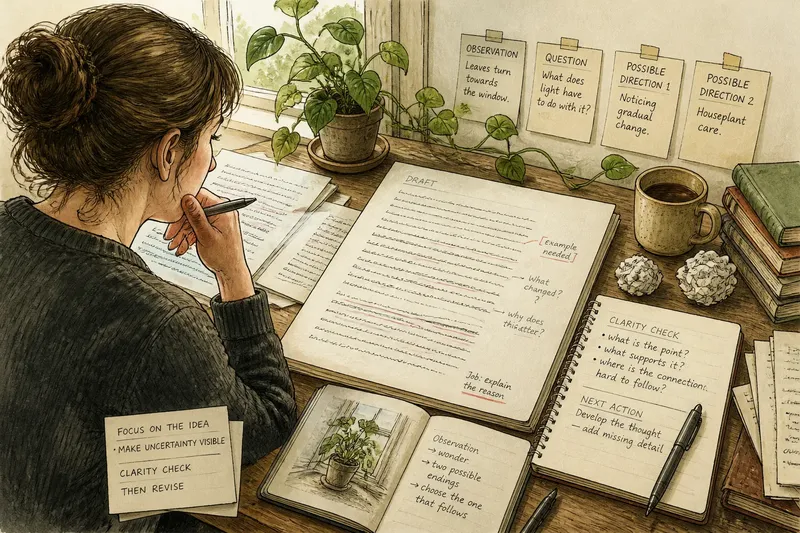
- Put a placeholder such as “[example needed]” where a supporting detail is missing. If you know what kind of detail would help, add a note about it; if not, keep drafting around the gap.
- Leave a clumsy sentence alone if its meaning is understandable. If it lets you continue, move on; if you cannot understand it yourself, rewrite it plainly enough to recover the thought.
- Mark competing directions in a few words. If one direction clearly serves the piece, follow it; if neither does, write a short passage for each and compare what each one lets you say.
- After a paragraph, note its job in a few words, such as “describe the change” or “explain the reason”. If the job is clear, continue; if it is not, add material that clarifies the paragraph’s purpose before polishing its sentences.
- When a sentence fix tempts you, identify the problem it would solve. If the wording blocks your meaning, repair it; if it is merely less elegant than you would like, leave it until the idea and order are clearer.
These marks are working decisions, not defects to hide. They help you tell whether the next useful action is to develop the thought, clarify a connection or refine wording.
How can you separate drafting from the clarity check?
Use two distinct passes, with a pause or a clear change of task between them. In the rough pass, follow the thought and mark what remains unclear. In the clarity check, read for the reader’s path: what is being claimed, what supports it, and where the connection becomes hard to follow?
Say you are drafting a short note about a houseplant whose leaves turn towards a window. You begin with that observation, add a paragraph wondering what light has to do with it, and then write two possible endings: one about noticing gradual change, the other about plant care. On the clarity pass, you choose the first ending because it follows from what you have actually described, remove the care advice, and revise the paragraphs to support that focus. The resulting draft has one discernible purpose rather than a polished opening attached to competing directions.
During the clarity pass, read once without changing anything. At the end of each paragraph, write a few words describing its job. If two paragraphs do the same job, consider combining them; if one has no clear job, decide whether to develop it or remove it before tuning individual phrases.
How do you know when the idea is ready for revision?
Readiness does not mean certainty. It means you can describe the current direction in a sentence and identify the main parts that make it legible. A reflective piece might connect an observation to a question and a thought; an argument might set out a claim and reasons that support it.
Try explaining the draft aloud without reading from the page. If you keep discovering a different central point as you speak, the idea may still be forming. If you can explain the point but the written version feels tangled, revise its structure and clarity rather than returning to unrestricted drafting.
Gaps do not automatically make a draft unready. The useful distinction is whether the central direction is clear enough to guide choices: if it is, revise the material around that direction; if it is not, develop the thought until you can state what the piece is trying to do.
What should you do with tempting sentence fixes?
Before changing a sentence, name the problem the change is meant to solve. If the wording obscures the meaning, make a plain repair; if the meaning is clear and the change is only a matter of style, return to the idea or paragraph structure first.
There is no need to ban editing during a first pass. A quick correction that restores meaning can help you continue, while a search for the perfect adjective rarely resolves an uncertain argument. Match the effort to the problem in front of you.
Which drafting and editing questions come up often?
Should I fix spelling in a first draft?
Correct an error if it makes the sentence hard to understand; otherwise, leave routine corrections for a later pass. Repeated spelling checks can interrupt the work without clarifying the idea.
What if I keep changing the opening?
Write a temporary heading or a plain sentence naming the current subject, then move to the next section. Return to the opening once you know what the whole piece is asking or showing.
Can a rough draft include questions to myself?
Yes, if a question helps you identify what you need to work out. For instance, “[what changed?]” points to a missing connection; answer it in the draft if it matters, or remove the passage if the question leads away from the piece’s direction.
How polished should a draft be before another person reads it?
Make it coherent enough for the reader to follow its direction, but do not spend time refining every stylistic choice first. Ask for feedback on a specific concern, such as the central idea, the structure or the wording, so the response suits the stage of the work.
Why is a clarity check more than proofreading?
Proofreading catches surface errors; a clarity check asks whether the reader can follow the thought. It may show that a paragraph belongs earlier, an example does not support the point, or the piece is answering a different question from the one it began with. Those are revision decisions, not copy-editing details.
For the first-draft trap, match the task to the stage. Let the rough pass develop the material, then use the clarity check to choose and organise it; polish sentences when their purpose is clear. As you revise, keep asking what each sentence helps the reader understand: that question makes useful editing easier to distinguish from polishing for its own sake.